
Do You Have a Pricing Problem, a Spending Problem, or a Capacity Problem?



Written by Megan Munsell, CPA | Published November 14, 2026
On this page
- The Bottom Line on Operational Constraints
- Which Constraint Is Actually Straining Your Business?
- Constraint Comparison Matrix
- 4 Ways These Problems Get Confused
- How to Diagnose Your Core Constraint
- 3 Real-World Business Profiles
- Diagnostic Checklist for Business Owners
- Ready to Fix the Constraints Holding Your Business Back?
There is a point in business growth where everything starts to feel heavier. Revenue is higher, you have more clients, maybe there is a team now, and far more money is moving through the business than there used to be. Yet somehow you still feel like you are working too hard for the amount of money left over.
So naturally, you start diagnosing yourself: “I need to charge more.” Or “I spend too much.” Or my personal favorite: “I just need to work harder.”
Those are three completely different diagnoses. If you fix the wrong one, you can actually make the business worse. Raising prices when your delivery model is broken leaves the operational problem intact. Slashing expenses when your team is already overloaded compounds your capacity crisis. Hiring more people when your services are underpriced simply scales an unprofitable model.
Heaviness is not a character flaw—it is information about the financial system you built.

TL;DR: The Bottom Line on Operational Constraints
When growth feels harder than it should, there are three distinct places to look:
- Pricing: Does each sale create enough gross profit after paying the real cost of direct delivery?
- Spending: Is the gross profit being consumed by overhead that your current scale cannot support?
- Capacity: Can the business deliver more work without relying on founder heroics, unbilled overtime, or quality drops?
These problems look nearly identical from the outside—revenue can grow while cash stays tight in all three scenarios.
Most importantly: The solution is never automatically higher prices, budget cuts, or a new hire. First diagnose the constraint, then fix the right link in the chain.
First: Which Constraint Is Actually Straining Your Business?
Comparing your business to generic advice often leads to wrong decisions because pricing, spending, and capacity answer completely different financial questions.
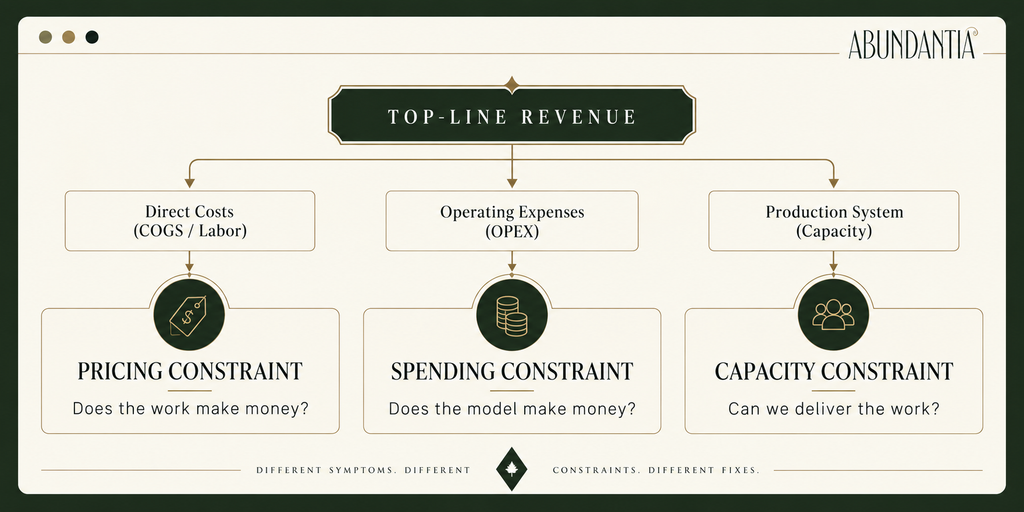
1. Gross Profit & Pricing: Does the Service Itself Work?
A pricing problem exists when the economics of what you sell do not leave enough gross profit to support delivery and operate the company.
$$\text{Revenue} – \text{Direct Delivery Costs} = \text{Gross Profit}$$
$$\text{Gross Margin} = \left( \frac{\text{Gross Profit}}{\text{Revenue}} \right) \times 100$$
Example: You sell a consulting engagement for $15,000 expecting $5,000 in direct labor costs ($10,000 Gross Profit / 66% Gross Margin). But scope creep adds extra meetings, revisions, and senior oversight, pushing direct labor to $9,000. You still collected $15,000, but your gross profit dropped to $6,000 (40% Gross Margin). The price was designed for one delivery model, but you delivered another.
CFO Insight: Your price must cover more than the visible work. It needs to support the actual delivery model behind the promise—including the non-billable hours, client management, and revisions nobody remembered to price.
2. Operating Margin & Spending: Does the Business Model Work?
A spending problem occurs when your core services generate healthy gross profit, but operating overhead (OPEX) consumes more cash than current revenue can sustain.
$$\text{Gross Profit} – \text{Operating Expenses} = \text{Net Profit}$$
Example: A business generates $100,000 in monthly revenue with $30,000 in direct delivery costs, leaving a strong $70,000 gross profit (70% Gross Margin). However, administrative payroll ($25,000), marketing ($15,000), software ($7,000), management ($12,000), and office/professional fees ($6,000) consume $65,000. Net profit vanishes to $5,000 (5% Net Margin). The service works, but the operating structure around it is too expensive for its current size.
3. Capacity & Production: Can the Delivery System Scale?
In a service business, labor is the production system. A capacity problem exists when demand is strong and unit margins are healthy, but the business cannot absorb additional work without delivery breaking.
According to the 2026 SPI Professional Services Maturity Benchmark, average billable utilization for professional services sits at 66.4%. Forcing a team to operate at 90%–100% utilization leaves zero buffer for sales, internal training, or unexpected project delays.
Constraint Comparison Matrix
| Operational Dimension | Pricing Problem | Spending Problem | Capacity Problem |
| Primary Symptom | Low gross profit despite steady sales volume. | Healthy gross profit consumed by overhead. | Solid profits, but quality drops and burnout spikes. |
| P&L Location | Direct Cost of Delivery / COGS line. | Operating Expenses (OPEX) line. | Delivery bottlenecks and high contractor fees. |
| Founder Impact | Providing unpaid labor to bridge delivery. | Stressed by high fixed monthly overhead. | Acting as the manual approval bottleneck. |
| Initial Fix | Enforce scope limits and adjust pricing. | Audit SaaS, admin overhead, and unaligned spend. | Standardize workflows and delegate delivery. |
4 Ways These Problems Get Confused
- Underpricing Can Look Like Overspending: When labor costs feel huge relative to revenue, cutting staff asks fewer people to deliver underpriced work.
- Scope Creep Can Look Like a Pricing Issue: Raising prices on unmanaged scope simply increases client expectations while scope creep continues to erode margins.
- Capacity Constraints Create Spending Problems: Overloaded teams force reactive hiring of expensive contractors and rush fees, inflating expenses.
- Cost-Cutting Can Create Capacity Problems: Slashing administrative support forces the founder back into lower-value delivery tasks, stalling business growth.
How to Diagnose Your Core Constraint
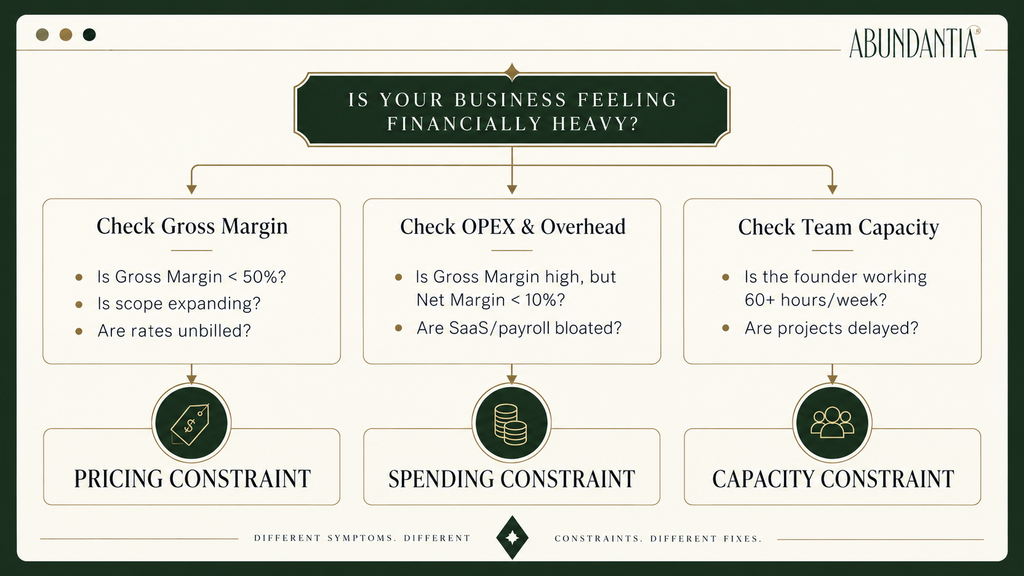
3 Real-World Business Profiles
Profile A: The Underpriced Consultancy
- Revenue: $1,200,000/year ($100,000/mo)
- Situation: Direct delivery labor costs $70,000/mo, leaving $30,000 gross profit.
- Diagnosis: Pricing & Scope Problem. Selling more volume under 30% gross margins will not create cash flow.
Profile B: The Over-Engineered Agency
- Revenue: $1,200,000/year ($100,000/mo)
- Situation: Direct delivery costs are $30,000/mo ($70,000 gross profit), but administrative overhead, software, and middle management consume $68,000/mo.
- Diagnosis: Spending Problem. Pricing is sound, but overhead expanded faster than revenue.
Profile C: The Founder Bottleneck
- Revenue: $1,200,000/year ($100,000/mo)
- Situation: Gross margins are 70% and net margin is 25%, but the founder works 65 hours a week and approves every client deliverable.
- Diagnosis: Capacity Constraint. Production requires process standardization and delegation, not pricing or cost cuts.
Diagnostic Checklist for Business Owners
Run through these eight questions during your next financial review:
- When revenue increases, does gross profit increase proportionally?
- Do you know the exact direct delivery cost for each service line?
- Is scope creep or unbilled revision work eroding your realized hourly rate?
- Are discretionary operating expenses tied to measurable business metrics?
- Are non-operating cash outflows (tax payments, debt principal, owner draws) causing cash strain rather than overhead spending?
- Is your delivery team operating above 75% billable utilization without operational buffers?
- Can your business comfortably onboard a new client tomorrow without founder heroics?
- Are you solving the constraint your business actually has, or reacting to personal self-blame?
Ready to Fix the Constraints Holding Your Business Back?
Stop guessing whether your business has a pricing, spending, or capacity problem. Partner with Abundantia Advisory to analyze your financials, optimize your service economics, and build a scalable operational model.
Schedule Your Strategic Discovery Call Today
Frequently Asked Questions
Start by reviewing what happens to the money from each sale. If direct delivery costs leave too little gross profit, investigate pricing and scope. If gross profit is healthy but overhead consumes most of it, review spending. If margins are healthy but deadlines slip and your team is stretched thin, examine capacity.
Higher revenue does not automatically mean more profit or available cash. Delivery costs, overhead, and extra work can absorb the increase. Cash can also be tied up in unpaid invoices or used for taxes, debt repayments, and owner draws. Review both profitability and the timing of money coming in and going out.
A price increase may help when your fees do not cover the actual cost of delivery and leave enough profit to support the business. First, check for scope creep, excessive revisions, and inefficient workflows. Understanding those costs helps you decide whether to adjust pricing, change the service scope, improve delivery, or combine these approaches.
Scope creep adds work without adding revenue. Extra meetings, revisions, and requests increase delivery costs and reduce the profit left from an engagement. Clear deliverables, revision limits, and a process for approving additional paid work help keep the service aligned with its price.
Gross profit is revenue minus the direct costs of delivering your services. Operating profit is what remains after subtracting operating overhead, such as administrative payroll, software, and office expenses. Reviewing both helps you see whether the pressure comes from service delivery or the structure supporting the business.
Review what each expense contributes to delivery, sales, or essential operations. Duplicate software, unused subscriptions, and spending without a clear purpose are useful starting points. Before cutting support or staff, consider whether the savings would create delays, reduce quality, or shift more work onto you.
Common signs include missed deadlines, growing backlogs, rushed work, frequent overtime, and a founder who must approve everything. Your team may be busy while projects still struggle to move forward. Look for bottlenecks, unclear responsibilities, and repeated tasks that could be standardized or delegated.
First, identify what is causing the overload. A new hire may help when demand consistently exceeds your team’s available capacity and the business can support the cost. If the pressure comes from underpriced services, unmanaged scope, or approval bottlenecks, address those issues as part of the hiring decision.
Megan Munsell is a CPA and fractional CFO with nearly 20 years of experience working with businesses ranging from small businesses to Fortune 50 organizations. Through Abundantia Advisory, she helps founders build stronger financial systems, improve profitability, plan for taxes, and make growth decisions with greater financial clarity.
Disclaimer: This article is for general educational purposes only and does not constitute individualized tax, legal, accounting, payroll, investment, or financial advice. Tax strategies and entity decisions depend on your specific circumstances, current law, and applicable federal, state, and local rules. Consult qualified professionals before implementing a tax or entity strategy.
Leave a Reply


This calendar gives solopreneurs and small biz CEOs a monthly roadmap for compliance, money strategy, and financial self-trust.
Whether you're DIYing or managing a team, this high-value tool helps you:
✅ Hit every IRS and state filing on time
✅ Build CEO habits like money dates and pricing boundaries
✅ Stay calm, confident, and cash-savvy month after month